
Statesville City Directory Collections
Statesville's historic directories survive in both a local shelf and online scans, but no one run supplies every year. The Iredell County Public Library Local History collection is the main local access point. Its research index identifies a Statesville and Iredell run for 1907 through 1910, a Statesville city-directory shelf from 1914 through 1992, later volumes from 1995 through 2003, Miller's volumes from 1932 through 1964, and Polk directories for 2004 through 2021. DigitalNC fills several early gaps with public scans. Treat the gaps between volumes as gaps in evidence, not proof that a household was absent.
| Statesville collection | Years located | Custody | How to consult it |
|---|---|---|---|
| Statesville and Iredell directory | 1907-1910, with a 1909-1910 scan | Iredell Library and DigitalNC | Catalog record and historical street sections |
| Statesville city-directory shelf | 1914-1992; 1995-2003 | Iredell Library Local History Room | Confirm a particular volume with library staff |
| Digitized Statesville volumes | 1916-1917, 1922-1923, 1928-1929, 1930-1931, 1932-1933, 1946-1947 | DigitalNC and holding institutions | Public scans and catalog metadata |
| Miller's and Polk directories | Miller's 1932-1964; Polk 2004-2021 | Iredell Library | Local-history shelf or staff assistance |
The collection is broad enough to support a dated household trail, yet each edition has its own coverage and publishing choices. A street entry can be especially useful after a surname search, while alphabetical and classified sections answer different questions. The library also holds local newspapers, maps, yearbooks, cemetery material, and house-history files that can test a directory finding against another dated record.
Statesville City Directory Scans by Year
DigitalNC makes several Statesville directory volumes available without replacing the library shelf. The 1916-1917 DigitalNC record, held by UNC-Chapel Hill Wilson Special Collections, is cataloged as record 25370. Other located scans include 1909-1910, 1922-1923, 1928-1929, 1930-1931, 1932-1933, and 1946-1947. Catalog information matters because it identifies the edition and holding institution rather than leaving a downloaded image separated from its date.
The DigitalNC record is the source for this view of a Statesville historical directory scan.
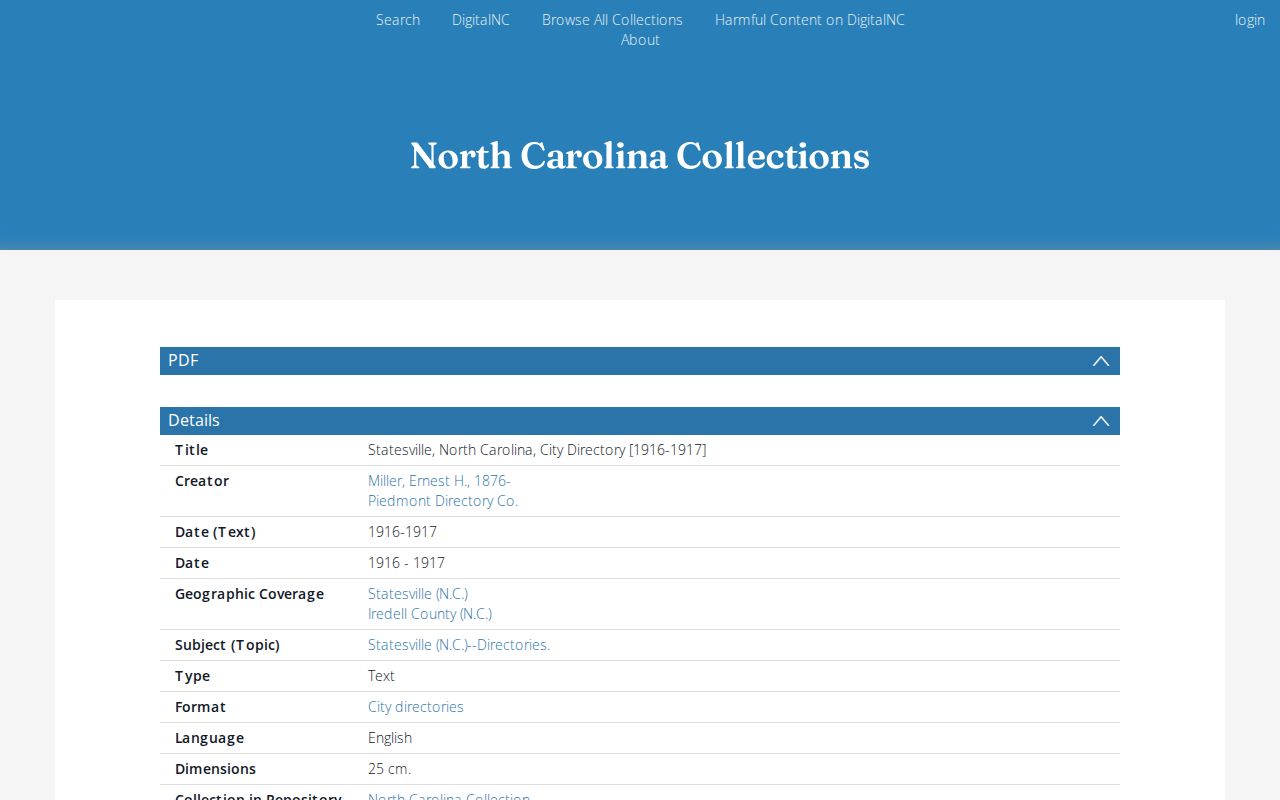
Use the record date, volume title, and page location when saving a Statesville directory result. A scan is a historical publication, not a claim about who is connected with an address today.
Miller's Official Statesville 1930-1931 described a general alphabetical directory, a classified business directory, a householders' or street directory, and miscellaneous information. The 1946-1947 Miller's volume is credited to Chas. W. Miller and Southern Directory Company. Polk entries begin much later. These changes in format are why a name search should be followed by the relevant street or household section when the volume has one.
Note: A volume's date and section heading are as important as a matching surname when comparing historical Statesville directories.
Statesville Directory Help at the Library
The library at 201 N Tradd Street is the practical fallback when a digitized scan is missing, hard to read, or outside the available online years. Its posted hours are Monday through Thursday from 8 a.m. to 8 p.m. and Friday through Saturday from 9 a.m. to 6 p.m. The Local History Room is on the third floor according to the library guide. Some resources are access-limited: Ancestry Library Edition is described as in-library, while HeritageQuest is identified as an online genealogy source. Staff can also help determine whether a directory, newspaper, map, or family file is the better record for a name or place.
The library's Local History page is the source for this local-history resource view.

The same library program identifies Statesville newspapers from 1874 through 1977, the Iredell Citizen from 1998 through 2008, Sanborn maps, school scrapbooks, Mitchell yearbooks, cemetery work, and DigitalNC links. Those materials give a second route when a printed entry is incomplete.
The Genealogical Society of Iredell is available by appointment through the Heritage Room and keeps family files, Bibles, local books, and private collections. Its listed contact is iredellgsic@iredellcountync.gov, extension 5384. It is appropriate to ask about a named collection that does not appear in a catalog; the research did not locate official runs for every type of alumni, congregation, fraternal, or funeral-home list.
Reading a Statesville City Directory Entry
An entry in a Statesville volume is a publisher's dated snapshot. Inspected 1916-1917 lines show a person, a spouse in parentheses where printed, a role or business notation, home or residence wording, and a street address. Some entries also carry office or telephone details. Preserve the text as printed, including initials and abbreviations. A directory line can document what the compiler printed for that edition, but it does not establish current residence, ownership, or a full family relationship.
| Named person | The head or other listed person, often abbreviated by initials |
|---|---|
| Parentheses | A spouse name when the publisher printed one |
| Role notation | A printed trade, business, or other identifying context |
| Home or residence text | Abbreviations such as h or r only as the page presents them |
| Street and number | A historical address to compare with maps and later editions |
- Criss-cross directory
- A directory section arranged by street and number rather than by surname, useful for a historical address check.
- Householder index
- A street-oriented list that can associate a printed household line with an address in that edition.
- Abbreviation key
- The volume's own explanation of shortened terms. Do not expand a mark beyond what the source supports.
“Jno” for John, “Robt” for Robert, a faint initial, and a spouse name can all matter when scanning a page. Compare spelling variants before deciding that a person is missing. The 1916 and 1932 scans also show why a street section may succeed after an alphabetical search fails.
Statesville City Directory Spelling Clues
The 1932-1933 Statesville volume includes the warning, “TO FIND A NAME YOU MUST KNOW HOW TO SPELL IT.” That local instruction is useful for scanned pages and optical text search. A faint letter, an initial, or a printed abbreviation can block a literal search. Try likely surname spellings, first-name forms, initials, and a spouse's name, then inspect the street section if the alphabetical list has no useful result.
Do not repair an unclear line from memory. Save the page image and record the printed form, volume, and date. If two editions differ, the change may reflect a move, a marriage, a new business connection, a temporary residence, or simply a publisher's convention. The next directory, a newspaper notice, a Sanborn sheet, or a recorded instrument can provide the needed context.
Statesville Directories and Map Evidence
Historical volumes work best beside records that answer a different question. The library's Digital Sanborn list includes Statesville editions for 1885, 1890, 1895, 1900, 1905, 1911, 1918, 1925, and 1930. A Sanborn sheet can show building footprints, uses, street names, block numbers, water mains, and fire hydrants. It does not supply a complete occupant list. Newspapers, deeds, cemetery material, and archive files can likewise corroborate a dated person or address without turning one directory line into a complete biography.
The Genealogical Society of Iredell County resource page is the source for this view of family-file and local-collection access.
Family files and Bibles can help with a surname that drops out of a formal index, while a map or deed helps determine whether two printed street references are the same place. Keep each source's date next to the fact it supports.
For a modern parcel or street-level trail, use the separate Statesville street directory route rather than extending a historical entry into a current-address claim.
Statesville Directories Across Time
Statesville became Iredell's county seat in 1789, after the county formed from Rowan County in 1788. The town was founded around Fourth Creek in January 1789, had an early log courthouse around 1790, and incorporated in 1847. City-directory publishing provides a later, human-scale record of that developing place: a 1907-1910 Statesville and Iredell run, early scans beginning with 1909-1910, later library shelves, Miller's volumes, and Polk directories through 2021.
- 1907-1910: Statesville and Iredell directory run, including the digitized 1909-1910 volume.
- 1914-1992: Statesville city-directory shelf located at the library.
- 1932-1964: Miller's Statesville run listed by the library, with selected DigitalNC volumes.
- 1995-2003: Later Statesville city-directory shelf run.
- 2004-2021: Polk Statesville and Iredell directories listed in the library research index.
The Bostian Bridge derailment of August 27, 1891 is a distinct local-history and newspaper search anchor between the earliest county records and later directory volumes. It is a useful reminder that newspapers can carry event context that a printed volume was never designed to record.
Note: Historical Statesville directories change in format and coverage, so use the cited edition rather than a modern summary when documenting a dated entry.
Tracing Statesville City Directory Households
Trace a household from the earliest nearby volume forward, not backward from an assumed identity. Start with the exact printed name or street number, capture the page and edition date, then compare the next available directory. Pairing city-directory years with census-era resources, newspapers, Sanborn maps, obituaries, cemetery material, deeds, and archive files can separate a move from a name overlap. An owner on a deed may not be the person a directory lists at the address, so record the source role rather than merging them.
- Choose the directory volume nearest the date being investigated and search name variants.
- Copy the printed name, street, notation, page, volume title, and publication date.
- Check the street or householder section when the volume provides one.
- Compare the next available volume and mark each change as a question until another source supports it.
- Pair the dated line with a newspaper, map, cemetery record, deed, or archive file suited to the question.
A disappearance from the shelf can mean many things: the person moved, died, was omitted, changed a printed name form, or fell in a year gap. The library and State Archives are the fallback chain for a missing connection. Historical directories are valuable precisely because they preserve a date, but their limits deserve the same care as their details.